During the last week I have been trying to continue writing my thesis, but it advances very slowly. I however did some interesting research about the relation between on-demand price reductions in EC2 (focus on US East region) and the hardware cost reduction that happened over time. A draft of the appendix containing this research is embedded here.
If this text appears as small as it does for me, you can download the PDF here as well.
Showing posts with label On-Demand. Show all posts
Showing posts with label On-Demand. Show all posts
Monday, March 28, 2011

Sunday, December 5, 2010
EC2 On-Demand/Reserved Pricing History
Amazon EC2 instance prices are not fixed, in a way that Amazon has the ability to change these prices at any given moment in time. It should not come as a surprise that prices have decreased over the last couple of years. This is a rather natural phenomenon ... since the instances that existed back then do still have the same specifications, but their hardware cost have decreased dramatically. So, Amazon is able to keep being competitive by lowering its prices. When making a division between the different instance types, this possibility should be taken into account. If one should pay the reserved instance rate for the rest of the period the instance was rented, the price change that is predicted could be taken into account as a discount on the on-demand prices. To be able to make such conclusions one should have a look at the price decreases that happened in the past, so I'll give a little history overview of the EC2 instances and their pricing.
The history of EC2 and its instances is given in a chronological order, when prices did change they will be presented as well:
The history of EC2 and its instances is given in a chronological order, when prices did change they will be presented as well:
- [24/08/2006] Amazon Elastic Compute Cloud beta is announced. There was only one instance type (1.7GHz Xeon processor/1.74 GB of RAM) available for $0.10 per hour.

- [22/10/2007] EC2 in unlimited beta and new instance types are announced.

- [29/05/2008] High-CPU instances announced.

- [23/10/2008] EC2 exits beta and offers SLA with commitment of 99.95% availability within a region.
- [23/10/2008] EC2 instances running Windows Server available.

- [10/12/2008] the European Region is added.
- [08/01/2009] the AWS management console is launched.
- [03/03/2009] Windows instances announced for the EU region.
- [12/03/2009] EC2 introduces Reserved instances

- [15/04/2009] Reserved instances now available in Europe.
- [20/08/2009] prices of Reserved instances are decreased.

- [30/09/2009] distinction between instances running Windows and instances running Windows with Authentication Services is removed (the price of the general Windows instances is put in place).
- [27/10/2009] new High-Memory instances announced.

- [27/10/2009] all other on-demand prices are lowered with up to 15%
- [03/12/2009] Northern California region launched.
- [14/12/2009] Amazon EC2 Spot instances announced.
- [23/02/2010] Extra Large High Memory instances get introduced.

- [23/02/2010] EC2 instances with Windows now available.

- [29/04/2010] Asia Pacific (Singapore) Region announced
- [13/07/2010] Cluster Compute instances announced.

- [01/09/2010] Lower prices for High Memory Double and Quadruple XL instances.

- [09/09/2010] Micro instances are announced.

- [21/10/2010] AWS Free Usage Tier introduced.
- [15/11/2010] Cluster GPU instances announced.

- [03/12/2010] Free monitoring of CPU, disk and network performance metrics through CloudWatch is introduced.


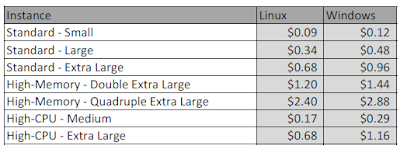
Effective September 1, 2010, we've reduced the On-Demand and Reserved Instance prices on the m2.2xlarge (High-Memory Double Extra Large) and the m2.4xlarge (High-Memory Quadruple Extra Large) by up to 19% and the Reserved Instances by up to 17%. If you have existing Reserved Instances your hourly usage rate will automatically be lowered to the new usage rate and your estimated bill will reflect these changes later this month.You however still paid the full one-time fee, so these possible changes could still be taken into account. We notice however that not that many price reductions have happened in the EC2 history. Most of the new prices were made when a new instance type was introduced. The only real general price reduction happened in October 2009, when all on-demand prices were lowered up to 15%. But prices will probably have to change more often in the future since market pressure will rise.
Thursday, October 21, 2010
On-Demand vs Spot EC2 Instances
I searched the web to find some differences between spot and on-demand instances, and the issues that rise when making a choice between those two:
- Found on this website: Wouldn’t it be the cheapest to choose only spot instances and set a price equal to the on-demand instance prices? In theory, our pricing should never be worse than what we pay currently and would most likely be much better. The problems with these techniques: all your instances may get terminated at the same time as the price rises above on-demand (which it already did).
- Found in this article "An introduction to Spot Instances" by Amazon: it is a tutorial that tells you step-by-step how to use spot instances through the AWS Management Console. It states as well for what kind of applications (with concrete examples) spot instances are useful:
Spot Instances are well suited to a number of different kinds of applications. In general, they can save you money if your application doesn’t depend on instances being started immediately, can start and perform useful work without manual intervention, and can resume work after being interrupted.
Finally, there are a number of best practices that are good to keep in mind when running applications on Spot Instances in order to minimize the potentials impact from your instance being interrupted: save your work frequently (add checkpoints/split up your work), test your application, minimize group instance launches, track when spot instances start and stop and access large pools of compute capacity.
- Found on this website: "I think this means that over time people will realize that spot instances are feasible for a wide variety of workloads. There will be a psychological barrier for a while, but it will be overcome eventually." Why not just bid the on-demand price? "The fact that Amazon controls the spot price, still doesn't change the fact that unless there is a capacity problem with on-demand, people don't have any reason for bidding more than the on-demand price." "If everyone adopted your idea and bid at the on-demand price, that would invariably drive the spot pricing up to equal the on-demand... and then what have we gained?" "AWS spot price *may* be determined by supply and demand, but doesn't have to be. This is because there is only one seller."
ABSTRACT Cloud computing provides users an efficient way to dynamically allocate computing resources to meet demands. Cloud providers can offer users two payment plans, i.e., reservation and on-demand plans for resource provisioning. Price of resources in reservation plan is generally cheaper than that in on-demand plan. However, since the reservation plan has to be acquired in advance, it may not fully meet future demands in which the on-demand plan can be used to guarantee the availability to the user. In this paper, we propose an optimal virtual machine placement (OVMP) algorithm. This algorithm can minimize the cost spending in each plan for hosting virtual machines in a multiple cloud provider environment under future demand and price uncertainty. OVMP algorithm makes a decision based on the optimal solution of stochastic integer programming (SIP) to rent resources from cloud providers. The performance of OVMP algorithm is evaluated by numerical studies and simulation. The results clearly show that the proposed OVMP algorithm can minimize users’ budgets. This algorithm can be applied to provision resources in emerging cloud computing environments.
Thursday, October 14, 2010
Region Comparison
I had a look at the pricing of EC2 instances for the different geographical regions. Of course not only the money cost should be considered when running an application in the cloud but also the latency the servers in these different locations cause (but you can think of applications that do not care). The prices of the different locations can be found on Amazons website and are presented by me here. A first remark is that only the US East region does offer cluster compute instances. I investigated two different things about the pricing in the different regions:
- What is the cheapest location to run a certain instance? The results can be found here. We notice that for Reserved instances US - N. Virginia is always the cheapest solution. For on-demand instances it is as well, but for Windows instances the EU and Asia region offer the same price.
- How does the price of reserved instances vs on-demand instances compare on these different locations? The results can be found here. We notice that except for Micro instances US East always offers the most advantageous reserved instances. For Linux instances we see no difference between the regions (both for the 1 and 3-year terms). For Windows instances on the other hand we notice that Reserved instances are advantageous after a shorter amount of time in the US regions. It is also remarkable that Micro instances are the only ones that are more quickly advantageous in all regions but the US East one.
Monday, October 11, 2010
Reserved vs On-Demand Instances
On Amazon EC2 these terms have the following meaning:
- Reserved instances:
They give you the option to make a low, one-time payment for each instance you want to reserve and in turn receive a significant discount on the hourly usage charge for that instance.
- On-Demand instances:
They let you pay for compute capacity by the hour with no long-term commitments. This frees you from the costs and complexities of planning, purchasing, and maintaining hardware and transforms what are commonly large fixed costs into much smaller variable costs.
Subscribe to:
Posts (Atom)